A Movie Cannot Live on Moments Alone: What Toxic Reveals About Attention, Emotional Experience, and the Promise We Make Audiences

Before Toxic: A Fairytale for Grown-Ups was released, I wrote a Story-First Trailer Review asking a relatively simple question:
Did the trailer make an emotionally compelling promise that the story would be worth experiencing?
I had concerns.
But a trailer is not a film.
And I wanted the film to prove me wrong.
So I went to see Toxic in a theater.
There was another reason.
The ambition surrounding Toxic was not modest. This was being positioned as Indian cinema thinking beyond its traditional boundaries—a film with the scale, technical ambition, production values, and international aspirations to travel beyond India and even beyond the Indian diaspora.
That interests me enormously.
Because I want Indian cinema to travel.
I want our filmmakers to create films that audiences in Boston, Berlin, Buenos Aires, Seoul, Lagos, Tokyo, and London can experience not as curiosities from another culture, but simply as great stories.
That is why I spent 194 minutes with Toxic.
And somewhere during those 194 minutes, another question began forming in my mind.
It was no longer:
Is this a good film?
It was something much more consequential:
What happens when the machinery for creating anticipation becomes more sophisticated than the storytelling required to fulfill it?
A Note Before We Begin
I wrote most of this reflection several days ago, after spending 194 minutes watching Toxic: A Fairytale for Grown-Ups in a theater.
I deliberately chose not to publish it immediately.
I wanted the experience to settle.
Because this was never intended to become another review declaring whether Toxic was a “hit,” a “flop,” a masterpiece, or a disaster. I was interested in a larger question the film had left behind:
What happens when cinema becomes extraordinarily effective at capturing our attention moment by moment, but struggles to transform those moments into a continuously accumulating emotional experience?
Since then, something interesting has happened.
A shorter English-language version of Toxic has been released in India—part of a film conceived with ambitions extending beyond its traditional linguistic and geographic audiences.
Its initial theatrical response has been extremely limited.
That result does not prove the argument I am about to make. Too many factors determine theatrical performance for any single release.
But it does make one question increasingly difficult to ignore:
What actually makes a story travel?
Language can make a film more accessible.
Distribution can make it available.
Marketing can make people aware of it.
Star power can make people curious about it.
Spectacle can capture their attention.
But none of those, individually or collectively, can guarantee that an audience will emotionally enter the story.
And that distinction sits at the heart of this reflection.
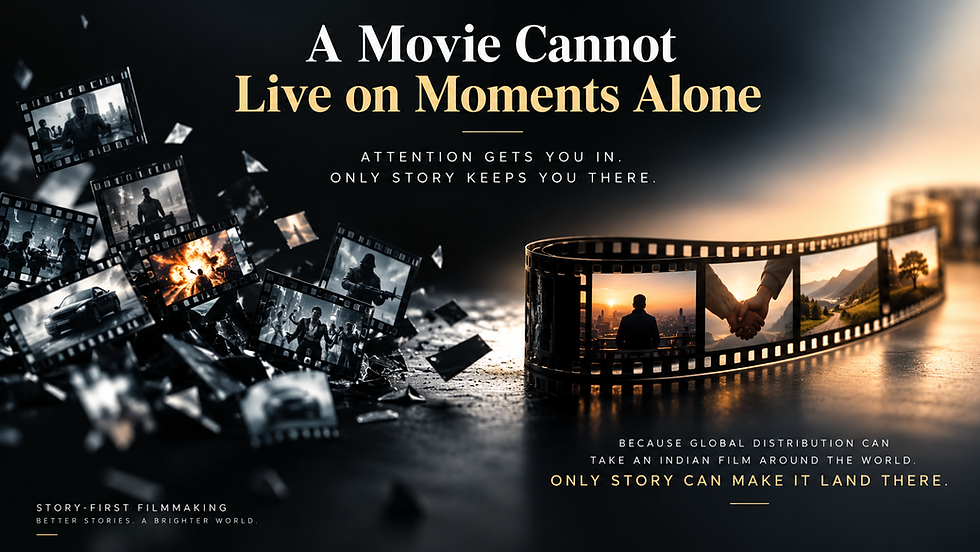
Because global distribution can take an Indian film around the world.
Only story and storytelling craft can make it land there.
When the Audience Arrives to Collect on the Promise
Marketing performs an essential function in filmmaking.
It creates anticipation.
A trailer makes a promise.
Posters reinforce it.
Interviews contextualize it.
Stars amplify it.
Publicity expands it.
Distribution carries it farther.
And eventually, after all the campaigns, interviews, social-media conversations, advance bookings, premieres, fan celebrations, promotional appearances, and declarations of ambition, something remarkably simple happens.
The lights go down.
The marketing department can no longer help.
The posters cannot help.
The social-media campaign cannot help.
The star's mythology cannot help.
The size of the budget cannot help.
The number of screens cannot help.
For the next few hours, there is only:
the film and the audience.
The audience has arrived to collect on the promise.
And storytelling must now deliver it.
Promise → Experience → Residue
This experience made me think about the audience journey in a slightly different way.
Perhaps every film ultimately travels through three critical states:
PROMISE → EXPERIENCE → RESIDUE
The marketing creates the Promise.
The film delivers the Experience.
And what remains after the audience leaves the theater is the Emotional Residue.
These three states should form an unbroken chain.
The promise creates an expectation of an experience.
The experience fulfills, exceeds, modifies—or violates—that expectation.
And the accumulated emotional experience determines what remains.
This matters because these three things are easily confused.
Marketing can manufacture anticipation.
Spectacle can capture attention.
Star power can generate admiration.
But none of those automatically creates emotional investment.
And without emotional investment, what exactly is supposed to remain when the spectacle ends?
Perhaps the Trailer Was More Accurate Than I Realized
When I evaluated the Toxic trailer before release, one characteristic troubled me repeatedly.
The trailer seemed relentlessly determined to keep my attention.
A dramatic entrance.
A weapon.
A provocative image.
A punch dialogue.
A threat.
A glamorous composition.
A burst of violence.
Another entrance.
Another cut.
Another visual escalation.
Another moment demanding attention.
I described this tendency as Shiny-Object-Here Syndrome.
Look here.
Now here.
Now here.
Now here.
The underlying concern was not that a trailer moved quickly. Trailers are compressed storytelling forms. Rapid editing can be entirely appropriate.
The question was whether all that stimulation was accumulating into something emotionally meaningful.
After watching the completed film, I found myself confronting an unexpected possibility:
Perhaps the trailer had communicated the film more accurately than I realized.
What I had interpreted as trailer grammar—the rapid punctuation, visual escalation, swagger, sensory resets, heroic framing, and succession of individually emphatic moments—felt remarkably close to my experience of the finished film.
The trailer had not merely been selling the movie.
In some respects, it appeared to be revealing the movie's storytelling philosophy.
A Film Is Not a Collection of Moments
Cinema certainly needs moments.
Great films are full of them.
The shower in Psycho.
The opening of Up.
The chestburster in Alien.
The courtroom eruption in A Few Good Men.
The first appearance of the shark in Jaws.
The Odessa Steps in Battleship Potemkin.
We remember moments.
But we remember great moments because the story gave them consequence.
A moment becomes powerful because of what came before it.
Because of what the character wants.
Because of what might be lost.
Because a relationship has changed.
Because information has been revealed.
Because hope has grown.
Because fear has accumulated.
Because a choice has become unavoidable.
Because something we have emotionally invested in is suddenly at stake.
Without that accumulation, a moment may still surprise us.
It may excite us.
It may shock us.
It may look extraordinary in a trailer.
It may generate a spectacular thirty-second social-media clip.
But surprise is not necessarily story.
Excitement is not necessarily engagement.
And stimulation is not necessarily emotion.
A movie cannot live on moments alone.
Are We Beginning to Design Films for the Clip?
That led me to a larger hypothesis.
I want to emphasize that word:
hypothesis.
Toxic made me wonder whether a pattern is emerging across portions of post-pandemic Indian tentpole cinema:
Films increasingly engineered around a succession of individually marketable moments rather than a continuously accumulating emotional experience.
The distinction matters.
We now inhabit an entertainment ecosystem organized around fragments.
Teasers.
Motion posters.
Character reveals.
First-look videos.
Star entrances.
Songs.
Reaction videos.
Shorts.
Reels.
Memes.
“Mass moments.”
Dialogue clips.
Action sequences.
Opening-weekend celebrations.
Every one of these can be valuable marketing material.
But what happens if the logic of marketing begins migrating backward into the architecture of the film itself?
What happens if scenes increasingly need to produce moments that can circulate independently?
What happens if characters must repeatedly announce themselves?
What happens if visual escalation replaces dramatic escalation?
What happens if editing is asked constantly to renew attention rather than deepen experience?
And perhaps the most important question:
What happens when films become extraordinarily effective at generating moments but progressively less capable of creating journeys?
I don't yet know whether this hypothesis is correct.
It deserves more rigorous study across a wider sample of films.
But I believe the question is worth asking.
Attention Is Not Emotional Engagement
Modern entertainment is engaged in a relentless competition for attention.
Cinema competes with streaming.
Streaming competes with YouTube.
YouTube competes with Instagram.
Instagram competes with games.
Games compete with notifications.
Everything competes with the screen already sitting in our hands.
The understandable filmmaking response may be:
Never allow the audience's attention to wander.
Something must always happen.
But I have spent much of my professional and personal life learning that continuous attention and meaningful engagement are not the same thing.
What Fighting Fires Taught Me About Attention
Throughout my management consulting career, I have worked alongside executives responsible for extraordinarily complex organizations and transformations.
Many lived inside an almost continuous sequence of attention-demanding events.
A customer problem.
A missed milestone.
A regulatory concern.
A difficult meeting.
A financial variance.
A technology failure.
A personnel issue.
Another escalation.
Another decision.
Another fire.
And then another.
One piece of advice I repeatedly offered during executive coaching was deceptively simple:
Make time to reflect.
Not because the fires were unimportant.
Precisely because they were important.
The human mind needs opportunities to step outside the succession of events—to process what happened, recognize patterns, connect causes and consequences, reconsider assumptions, extract learning, and allow individual experiences to coalesce into something more valuable.
Judgment.
An executive can spend an entire day responding brilliantly to individual events and still miss what those events are collectively trying to reveal.
And increasingly, I wonder whether storytelling faces a remarkably similar problem.
A film can keep giving an audience something new to process every few seconds.
Another cut.
Another confrontation.
Another revelation.
Another spectacle.
Another line designed for applause.
Another burst of violence.
Another visual surprise.
Another attention reset.
Each may succeed individually.
But what are they becoming collectively?
Because attention can be captured moment by moment.
Meaning has to accumulate.
The Attention Economy Has Made This Personal Too
I think about this beyond my professional life.
I think about it as a father.
My daughter is growing up in a world very different from the one in which I learned to concentrate.
Her generation has inherited an extraordinary technological environment: multiple screens, endless information, notifications, social platforms, streaming libraries, short-form video, messaging, news, entertainment and knowledge available almost instantaneously.
There is enormous value in that world.
There is also an unprecedented competition for her attention.
And one piece of advice I have found myself giving her resembles what I once told executives:
Intentionally untether from it sometimes.
Not because screens are inherently harmful.
Not because technology should be rejected.
But because some experiences need time to become something inside us.
We need moments when we are no longer responding to the next stimulus.
Moments to think.
To connect.
To remember.
To question.
To feel.
To allow experiences to settle long enough for us to discover what they meant.
Perhaps, occasionally, we need to detox from the endless competition for our attention.
No Toxic pun intended.
Storytelling Requires Something the Attention Economy Does Not
And that brings us back to cinema.
The danger is not fast editing.
It is not action.
It is not spectacle.
It is not even relentless pacing.
Extraordinary films have used all of them.
The danger arises when filmmakers begin confusing the audience's continued attention with the audience's growing investment.
They are fundamentally different.
Attention asks:
What happens next?
Curiosity asks:
Why is this happening?
Emotional engagement asks:
What happens to them?
Intellectual engagement asks:
What does this mean?
Relevance asks:
What does this have to do with me?
Resonance asks:
What will I carry from this into the world outside the theater?
Those latter questions require something that cannot always be manufactured through another cut.
They require accumulation.
A look gains meaning because of what happened twenty minutes earlier.
A silence becomes painful because we understand the relationship between two people.
A decision becomes terrifying because we know what the character stands to lose.
A seemingly ordinary object can devastate us because the story has transformed what that object means.
Sometimes an audience needs silence.
Sometimes we need to watch someone think.
Sometimes a relationship needs room to breathe.
Sometimes we need anticipation before payoff.
Sometimes we need vulnerability before power.
Sometimes we need uncertainty before revelation.
Sometimes we need stillness before violence.
And sometimes nothing externally spectacular needs to happen because something enormously important is happening inside the character—and inside us.
That is one of storytelling's great paradoxes.
A film can become increasingly successful at preventing us from looking away while becoming progressively less successful at giving us something worth remembering.
Because:
Attention is captured in moments.
Emotion accumulates across moments.
Meaning emerges from the connections between them.
And resonance is what remains when we finally have time to reflect.
Perhaps that is why the question filmmakers should ask is not merely:
“Are they still watching?”
But something considerably more demanding:
“What is all this watching becoming inside them?”
Global Cinema Is Not a Production Value
This is where my disappointment with Toxic became something more than disappointment with one film.
I went to the theater partly because of its global ambition.
And I believe Indian cinema should have enormous global ambition.
But perhaps we need to become much more precise about what global-caliber filmmaking actually means.
It does not mean making an Indian film look like Hollywood.
It does not mean bigger explosions.
It does not mean expensive VFX.
It does not mean English dialogue.
It does not mean international locations.
It does not mean technically sophisticated cinematography.
It does not mean enormous budgets.
And it certainly does not mean simply distributing the film internationally.
All of those things can contribute to a film's reach.
None guarantees resonance.
Because there is an important distinction:
Distribution determines how far a film can reach.
Story determines how deeply it can land.
A film can open on thousands of screens around the world and still depend primarily on an audience that already understands its stars, its cinematic grammar, its cultural shorthand, and the mythology surrounding its performers.
That is international distribution.
It is not necessarily global resonance.
Beyond the Diaspora
For Indian cinema, I believe this distinction is especially important.
Our diaspora is an extraordinary audience.
But if our global ambition stops there, we are leaving enormous storytelling potential unrealized.
The real test is much harder.
Can an audience member who has never seen KGF care about Raya?
Can someone who does not know why Yash is called a “Rocking Star” understand why this character matters?
Can someone with no relationship to Indian star culture enter the story without needing that cultural prerequisite?
Can the character generate his own emotional gravity?
That is where character becomes more powerful than celebrity.
As I wrote in the trailer analysis:
Celebrity can travel only as far as recognition allows.
Character can travel anywhere.
Pixar did not need audiences around the world to know Carl Fredricksen before Up began.
It made them care about him.
Jason Bourne did not become compelling merely because Matt Damon was famous.
Robert McCall does not become dangerous merely because Denzel Washington possesses extraordinary screen presence.
In each case, star power may bring something valuable to the film.
But eventually the actor must disappear sufficiently for the character to arrive.
That is not Hollywood filmmaking.
That is storytelling.
Indian Stories Do Not Need to Become Less Indian
There is another danger in conversations about “global” cinema.
We can mistakenly conclude that Indian films must somehow become culturally diluted to travel.
I believe precisely the opposite.
Parasite did not stop being Korean.
Roma did not stop being Mexican.
Crouching Tiger, Hidden Dragon did not stop being Chinese.
The great international films that travel often remain deeply rooted in their cultures.
What crosses the border is not cultural neutrality.
It is human recognizability.
Love travels.
Loss travels.
Fear travels.
Ambition travels.
Jealousy travels.
Parenthood travels.
Loneliness travels.
Betrayal travels.
Sacrifice travels.
The desire to belong travels.
The terror of losing someone travels.
The longing to become something more than we are travels.
India does not need to become less Indian to tell stories to the world.
We need to become more deeply human in the way we tell Indian stories.
The Marketing–Storytelling Gap
And this brings me back to the experience that started this reflection.
The problem is not that films should stop marketing themselves aggressively.
Nor should filmmakers stop making ambitious claims about what they hope to accomplish.
Ambition should be encouraged.
Indian filmmakers should dream audaciously.
Our films should attempt things we have never attempted.
Our technology should improve.
Our craft should improve.
Our distribution should expand.
Our filmmakers should compete for audiences everywhere.
But the larger the marketing promise becomes, the greater the storytelling obligation becomes.
Because marketing creates an expectation that storytelling must eventually inherit.
And if the distance between those two grows too wide, something valuable is damaged.
Not merely the reputation of one film.
Audience trust.
An audience can be persuaded to buy a ticket through anticipation.
It cannot be persuaded to feel something it did not experience.
That distinction may ultimately matter far more than opening weekend.
The Film Industry Has Become Very Good at Creating Anticipation
Perhaps one of the most important questions facing high-budget Indian cinema is therefore not whether we know how to create spectacle.
Clearly, we do.
It is not whether we can mount large productions.
We can.
It is not whether Indian stars can command enormous attention.
They can.
It is not whether our marketing organizations can manufacture extraordinary anticipation.
They demonstrably can.
The question is whether our storytelling capability is evolving at the same speed as our production and marketing capability.
Because if those capabilities become structurally unbalanced, the industry can find itself spending progressively more money to create progressively larger promises that stories must somehow fulfill.
That is not primarily a creative problem.
It becomes an operating-model problem.
And eventually, an economic one.
What I Carried Out of the Theater
When the lights came back on after Toxic, I wasn't thinking primarily about whether I had seen a hit or a flop.
Box-office numbers will answer their own questions.
I was thinking about the experience itself.
For 194 minutes, an extraordinary amount of filmmaking machinery had been deployed to hold my attention.
And yet I kept searching for the emotional journey underneath it.
That distinction has stayed with me.
Because perhaps the ultimate measure of storytelling is not how many times a film makes us look.
It is how deeply it makes us care.
Not how many moments we remember seeing.
But what those moments accumulated into.
Not merely what happened on the screen.
But what happened inside us while we watched it.
And what remained after we left.
That is emotional residue.
The Lesson Is Not to Dream Smaller
I don't want the lesson from Toxic to be that Indian cinema should reduce its ambition.
Quite the opposite.
Dream bigger.
Build extraordinary worlds.
Use the best technology available.
Create spectacular images.
Employ our greatest stars.
Take Indian films onto thousands of screens.
Compete for audiences in every country.
Push the boundaries of what Indian filmmaking can accomplish.
But remember what all of that machinery exists to serve.
The audience's experience of the story.
Because the greater the spectacle, the more important emotional clarity becomes.
The greater the star, the more important the character becomes.
The greater the budget, the more disciplined the storytelling must become.
The greater the global ambition, the more universal the human doorway must become.
And the bigger the promise...
the more disciplined the storytelling must become to keep it.
That is not an argument for smaller Indian cinema.
It is an argument for deeper Indian cinema.
Because global distribution can take an Indian film around the world.
Only story and storytelling craft can make it land there.
👉 Are you ready to see your film through the lens of Story-First Intelligence?
🟢 Learn more. Get leveled-up. Join the Rewrite.
📍 Explore The Story-First Workbook

And it starts with you.
The Rewrite Generation begins with you. 🎬🔥
Right stories. Told right. Together.


Comments