The Producer’s Greatest Risk Is Not Budget. It’s Story.


Why Greenlighting Is the Most Important Decision in Filmmaking
1. The Risk Everyone Talks About
When producers in the Indian film industry talk about risk, the conversation almost always sounds the same.
What is the budget?
Which star is attached?
How many shooting days?
What is the satellite deal?
What is the OTT deal?
How much should we spend on marketing?
What is the opening weekend projection?
What if a big film releases the same day?
These are the risks that dominate conversations in offices, trade events, film markets, and late-night industry dinners. These are the risks that appear in spreadsheets, investor decks, and production meetings.
But there is one risk that is almost never discussed openly — even though it is the risk that decides everything:
What if the story itself doesn’t work?
Not the dialogues.
Not the cinematography.
Not the casting.
Not the songs.
The story.
Because if the story does not work, then everything that follows — the shoot, the edit, the marketing, the release — becomes an expensive exercise in damage control.
Films don’t usually fail because the camera was bad.
Films don’t usually fail because the locations were wrong.
Films don’t usually fail because the marketing team didn’t try hard enough.
Films fail because the decision to make the film was wrong in the first place.
That is not a production problem.
That is not a marketing problem.
That is a greenlighting problem.
And greenlighting is the producer’s decision.
Which is why the producer’s greatest risk is not budget.
The producer’s greatest risk is story.

2. Decision Risk vs Execution Risk
In filmmaking, as in business, there are two kinds of risk.
Execution Risk and Decision Risk.
Execution risk is what most producers spend their time worrying about:
Will the film go over budget?
Will the schedule slip?
Will the actor’s dates change?
Will the weather affect the shoot?
Will the VFX be delivered on time?
Will another big film release on the same weekend?
These are real risks. They can hurt a film. They can make a film more difficult to produce. They can reduce margins. They can create stress and chaos during production.
But execution risks share one important characteristic:
They can be managed.
Good line producers, good planning, good scheduling, good contracts, good production management — all of these exist to manage execution risk.
But there is another type of risk that is far more dangerous.
Decision Risk.
Decision risk happens at the very beginning, long before the camera rolls.
It is the risk of answering one question incorrectly:
Should this story be made into a film?
If that decision is wrong, then:
A perfectly planned shoot cannot save the film.
A brilliant actor cannot save the film.
Beautiful cinematography cannot save the film.
A great background score cannot save the film.
A massive marketing campaign cannot save the film.
A big opening weekend cannot save the film for long.
Because the audience eventually asks a very simple question:
“Is this story worth my time?”
If the answer is no, the film collapses — not because of execution, but because of the decision that started it all.
Execution risk can be managed.
Decision risk cannot be fixed later.
You can manage a difficult shoot.
You cannot manage a weak story.
And yet, most producers spend far more time managing execution risk than evaluating decision risk.
That is the imbalance that is hurting the industry.
3. From Boardrooms to Film Sets — The Same Lesson
Over the course of my career in business transformation, I worked with large organizations trying to transform themselves in an ever-changing world. New strategies were developed. New technologies were implemented. New operating models were designed. Enormous amounts of money were invested.
And yet, study after study showed the same uncomfortable statistic:
Nearly 70–75% of business transformations fail.
At first, most executives assume these transformations fail because of poor strategy or poor execution. But over time, a different pattern emerges.
Transformations rarely fail because the strategy was completely wrong.
They rarely fail because people did not work hard enough.
They rarely fail because the organization lacked intelligence or capability.
They fail because people do not believe in the change.
They fail because the change narrative is weak.
They fail because employees are not emotionally engaged.
They fail because the story of the future is not believable, not compelling, not meaningful to the people who must carry it forward.
In other words, they fail because of decision-making failures around people engagement and the narrative of change.
Now think about what a film really is.
A film is, at its core, a two- or three-hour change narrative.
A character wants something.
The world resists.
The character struggles, fails, learns, changes, and becomes someone new.
And the audience must go on that journey with the character.
If the audience does not believe the change, the film fails.
If the audience is not emotionally engaged in the journey, the film fails.
If the audience does not find the story relevant or meaningful, the film fails.
In business, if people don’t believe the change, the transformation fails.
In cinema, if the audience doesn’t believe the story, the film fails.
In both cases, you can have:
Great strategy / a great concept
Great execution / great production
Great technology / great cinematography
Great teams / great actors
But if the core narrative does not land with the people it is meant for, the outcome collapses.
That is why, in business transformation, the most important decisions are not just about technology or process — they are about people and narrative.
And in filmmaking, the most important decision is not about cameras or locations or even stars.
It is about story.
Which means the greenlight decision is not just a creative decision.
It is a decision about whether millions of people will care about what you are about to make.
That is not a small decision.
That is the decision.
4. The Decision That Shapes an Industry
Every industry is shaped by the decisions its leaders make.
In cinema, the people who make the most important decisions are not always the actors, or the directors, or the technicians.
They are the people who decide which stories get told.
They are the people who say yes.
They are the people who say no.
They are the people who decide where money, time, and talent will be invested.
They are the producers.
Producers don’t just finance films.
Producers' finance decisions.
And the most important decision a producer makes is not which camera to use, or which location to shoot in, or which release date to target.
The most important decision a producer makes is much simpler and much more dangerous:
Is this story worth making into a film?
If the answer is yes — and the story is strong — many problems can be solved along the way.
If the answer is yes — and the story is weak — no amount of excellence in other departments can fully save the film.
Cameras don’t make great films.
Stars don’t make great films.
Budgets don’t make great films.
Marketing doesn’t make great films.
Decisions make great films.
And the most important decision in filmmaking is which story gets made.
The future of Indian cinema will not be decided by how many films we make every year.
It will be decided by which films we choose to make.
It will be decided by the day producers begin to treat greenlighting not as a formality, not as a gamble, not as a star-driven decision, but as the most important creative and financial decision in the entire filmmaking process.
Because in the end, the producer’s greatest risk is not budget.
The producer’s greatest risk is saying yes to the wrong story.
Why This Is Exactly Why the Greenlight Decision Needs a Framework
If the greenlight decision is the most important decision in filmmaking, then it raises a very uncomfortable question:
How are most greenlight decisions actually made?
In many cases, the decision is driven by some combination of the following:
A star is interested.
A director is excited about the idea.
The story sounds good in narration.
The genre is currently “hot.”
A remake worked recently.
A streaming platform is looking for similar content.
The music has potential.
The market seems favorable.
None of these are irrelevant. All of them matter. Cinema is both art and business, and market realities cannot be ignored.
But here is the problem:
Most of these are market signals.
Very few of these are story signals.
A star can make a film visible.
Marketing can make a film open.
Distribution can make a film accessible.
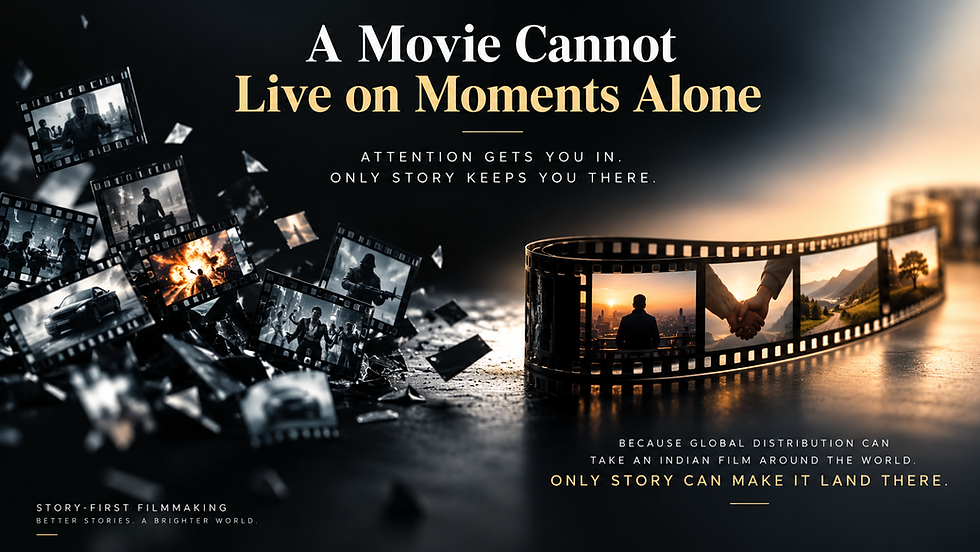
But only story can make a film work.
And yet, the one thing that ultimately decides whether the film works or not — the strength of the story — is often evaluated informally, subjectively, and inconsistently.
Imagine if other industries worked this way.
Imagine a venture capital firm saying,“We like the founder’s personality, the market is hot, and the pitch sounded exciting — let’s invest $50 million,” without a structured evaluation of the business model.
Imagine a pharmaceutical company saying,“The idea for this drug sounds promising — let’s release it,” without clinical trials.
Imagine an airline saying, “The aircraft looks good, and the pilot is confident — let’s fly,” without safety checklists.
No serious industry commits serious capital without a decision framework.
And filmmaking is a serious industry. It employs thousands of people, invests enormous amounts of capital, and produces cultural products that shape how a society sees itself.
So the greenlight decision cannot be based only on instinct, excitement, or market trends.
Instinct is important.
Experience is important.
Market awareness is important.
But for the most important decision in the entire process, producers also need something else:
A framework.
A checklist.
A disciplined way to ask the hard questions before saying yes.
Questions like:
Is the core concept strong and clear?
Is the premise built on real conflict, or just situations?
What is the film really about beneath the plot?
Does the main character truly change?
Is there a clear emotional journey for the audience?
Does the structure hold, or does the story collapse in the second half?
Is the world of the film fresh, specific, and believable?
Why will an audience care about this story?
Why should this film be made now?
These are not small questions.
These are greenlight questions.
And if these questions are not asked honestly at the beginning, they will be asked later by:
Confused actors on set
Frustrated directors in the edit room
Marketing teams trying to cut a trailer from an unclear film
Distributors negotiating hard
Audiences on social media
And eventually, by the box office
It is far better for a producer to ask these questions before the film is made than for the market to answer them after the film is released.
That is exactly why the greenlight decision needs a framework.
Not to kill creativity.
Not to make films formulaic.
Not to turn cinema into a spreadsheet.
But to ensure that before years of effort and crores of rupees are committed, one simple question has been rigorously examined:
Does this story deserve to be made into a film?
Introducing the Story-First Greenlight Litmus Test
This is the question that led to the creation of the Story-First Greenlight Litmus Test.
Not as a theory.Not as a film school lecture.
But as a practical decision tool for producers, directors, writers, and studios.
A simple but rigorous way to evaluate a story before it is greenlit.
The Litmus Test looks at a story across seven critical layers:
Concept – Is the core idea clear, compelling, and marketable in one or two sentences?
Premise – Is the story built on strong conflict and a clear dramatic engine?
Theme – What is the film really about? What is it trying to say?
Character – Does the protagonist have a meaningful arc and transformation?
Structure – Does the story hold dramatically from beginning to end?
World – Is the setting specific, believable, and visually interesting?
Audience Resonance – Why will people care? Why will they talk about this film after watching it?
The Litmus Test does not tell you how to write your film.
It helps you decide whether this film should be made.
Because once a film is greenlit:
Money is committed
Schedules are blocked
Actors sign contracts
Hundreds of people invest their time and energy
And the producer’s reputation is on the line
At that point, it is too late to ask fundamental story questions.
Those questions belong at the beginning.
They belong at the greenlight stage.
They belong on the producer’s table.
Case Study — When the Greenlight, the Story, and the Execution Come From the Same Mind
Recently, two Bollywood films — Dhurandhar and Dhurandhar: The Revenge — have been widely discussed in the trade not just for their box office numbers, but for something far more interesting.
Both films were driven by the same person — Aditya Dhar — as Producer, Writer, and Director.
This is important.
Because when one person carries the story from:
Idea
To script
To greenlight
To direction
To edit
To release
There is clarity of narrative intent from beginning to end.
There is no confusion about:
What the film is about
Who the main character is
What the emotional journey is
What the tone is
What the film is trying to say
Who the film is for
In many films, these decisions are split across multiple power centers:
A producer with a financial agenda
A star with an image agenda
A director with a visual agenda
A writer brought in later
A marketing team trying to position the film afterward
When too many agendas shape a film after the greenlight decision, the story often becomes diluted, confused, or compromised.
But when the greenlight decision, the writing, and the direction are aligned, the film moves with clarity. The entire production pulls in one direction. Marketing knows what to sell. The audience knows what to expect. Word of mouth becomes clearer because the film knows what it is.
This does not guarantee success. Nothing in cinema is guaranteed.
But it dramatically reduces decision risk.
Because the most dangerous situation in filmmaking is not when a film fails during execution.
The most dangerous situation is when a film begins without clarity about what story it is telling and why.
What made Dhurandhar interesting from a producer’s perspective was not just that it worked commercially.
It was that the greenlight decision, the story, and the execution were aligned from Day One.
That is not just a creative advantage.
That is a decision-quality advantage.
And in filmmaking, as in business, decision quality compounds.
Good decisions at the beginning make everything else easier:
Writing becomes clearer
Casting becomes smarter
Shooting becomes more efficient
Editing becomes tighter
Marketing becomes more focused
The audience experience becomes more coherent
Bad decisions at the beginning do the opposite:
Scripts get rewritten during shooting
Actors get confused about tone
Editors try to “find the film” in the edit room
Marketing sells a different film than what was made
Audiences feel the confusion — even if they cannot articulate it
Which brings us back to the central idea of this article:
The quality of films in an industry is a direct function of the quality of greenlight decisions made by producers.
When the greenlight decision is clear, disciplined, and story-first, the probability of success increases.
When the greenlight decision is driven by hype, trends, stars, or fear of missing out, the probability of failure increases — even if the opening weekend looks impressive.
Because in the long run, the industry is not built on openings.
It is built on films that endure.
And films that endure almost always begin with one thing:
A producer who said yes to the right story — for the right reasons.
Before You Say Yes to Your Next Film…
Every film begins with a moment that no audience ever sees.
There are no lights.
No camera.
No actors.
No set.
No music.
No teaser.
No trailer.
Just a room.
A few people.
A script.
And a decision.
Yes.
Or no.
That quiet moment — almost administrative, almost procedural — is the moment that decides the fate of the film.
Not the first day of shooting.
Not the trailer launch.
Not the release date.
Not the opening weekend.
The greenlight meeting.
That is where films succeed.
That is where films fail.
That is where crores are committed.
That is where years of people’s lives are committed.
That is where reputations are built or damaged.
That is where an industry slowly moves forward — or slowly loses its way.
And yet, for such an important decision, many producers still rely only on instinct, excitement, star availability, market trends, or fear of missing out.
Instinct matters.
Experience matters.
Market awareness matters.
But when the decision involves:
Crores of rupees
Hundreds of jobs
Years of effort
Your reputation
And the trust of the audience
Then instinct alone is not a strategy.
You need a way to ask the hard questions before you say yes.
That is why I created the Story-First Greenlight Litmus Test — not as a film theory document, not as a screenwriting manual, but as a decision tool.
A simple, structured way to evaluate a story across the key elements that determine whether a film works or not — before it is greenlit.
Before the budget is approved.
Before actors are signed.
Before schedules are blocked.
Before marketing money is committed.
Because once a film is greenlit, the industry moves into execution mode.
But by then, the most important decision has already been made.
Was this story worth making into a film?
The Litmus Test does not guarantee success. Nothing can.
But it helps reduce the biggest risk in filmmaking:
Saying yes to the wrong story.
If you are a producer, director, writer, studio executive, or investor involved in deciding which films get made, I invite you to use the Story-First Greenlight Litmus Test on your next project — before the decision is locked in.
It may be the most important conversation you have about your film.
Because in the end:
Budgets don’t decide the fate of films.
Stars don’t decide the fate of films.
Marketing doesn’t decide the fate of films.
Decisions decide the fate of films.
And the most important decision in filmmaking is still the simplest one:
Should this story be made into a film?
→ Run your story through it before you greenlight your next film
It might be the most profitable decision you make in your career.



Comments