The Day Bollywood Misunderstood Sholay - How Indian Cinema Lost Its Storytelling Mojo


For decades, Bollywood copied the spectacle of Sholay while forgetting the storytelling craft that made it great. The result was an industry that grew bigger — but not better.
In 1975, Indian cinema produced one of the greatest films it would ever make.
Then it spent the next four decades misunderstanding why that film worked.
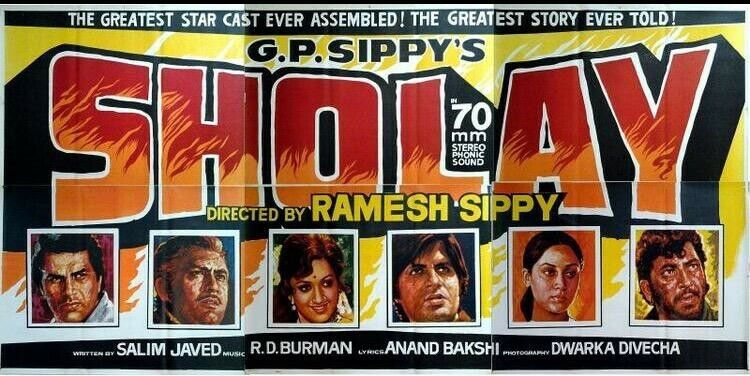
The film was Sholay.
It was bold.
It was cinematic.
It was wildly entertaining.
But above all, it was brilliant storytelling.
And that is precisely the lesson the industry failed to learn.
Instead of studying the craft that made Sholay work, Bollywood copied the ingredients it could see on the surface.
Action.
Stars.
Songs.
Scale.
The result was not another Sholay.
The result was the slow erosion of storytelling craft across an entire film industry.
Before Sholay: When Story Was the Spine of Indian Cinema
Long before the word Bollywood existed, Indian cinema was driven by writers and storytellers.
Directors such as Guru Dutt, Bimal Roy, Satyajit Ray, and Hrishikesh Mukherjee built films where the story came first.
Films like:
Pyaasa
Mother India
Pather Panchali
Guide
were commercial successes and artistic achievements.
They had characters who felt real.
They wrestled with moral dilemmas.
They explored society, love, failure, sacrifice, and redemption.
The audience did not walk out of those films thinking about box office numbers.
They walked out thinking about life.
In that era, nobody asked whether a film was art or commercial.
A great film was simply both.
Sholay: The Pinnacle of Storytelling Craft
When Ramesh Sippy released Sholay, he was not trying to create a formula.
He was trying to tell a great story.
The screenplay by Salim Khan and Javed Akhtar was meticulously crafted.
Every character had depth.
Jai.
Veeru.
Basanti.
Thakur.
Gabbar Singh.
Even minor characters were unforgettable.
The film balanced humor, tragedy, friendship, revenge, romance, and sacrifice with extraordinary precision.
It borrowed inspiration from Western cinema but remained deeply Indian in emotion.
Most importantly, Sholay understood something fundamental:
Spectacle without story is noise.
Story turns spectacle into cinema.
The Fatal Misreading
But the industry saw something different.
Instead of studying why the film worked, producers began copying what the film contained.
They copied:
big action scenes
multiple stars
loud villains
dramatic dialogues
lavish song sequences
What they did not copy was the storytelling discipline.
The formula that emerged looked something like this:
Star + Action + Songs + Comedy + Melodrama = Film
Story became optional.
And when story becomes optional, craft begins to collapse.
The Rise of the Star System
By the 1980s and 1990s, a new model had taken hold.
Films were no longer sold on scripts.
They were sold on stars.
A film could be financed if it had the right actor attached — even if the script was unfinished.
The result was predictable.
Scripts became weaker.
Actors became more powerful. They started manufacturing their "stardoms." More so now with the advent of social media.
And films increasingly became vehicles for celebrity rather than vehicles for story.
The industry began manufacturing stardoms, "Kings, and "Queens", sustaining it with publicity, paid media, and an ecosystem that rewarded familiarity over originality.
Inside this echo chamber, weak films were praised as blockbusters.
Outside it, audiences quietly began to drift away.
The Great Divide: “Art Film” vs “Commercial Film”
In the process, Bollywood invented a strange distinction.
Serious storytelling became labeled “art cinema.”
Entertainment became “commercial cinema.”
But this distinction had never existed in the golden era.
A film like Pyaasa was artistic and commercial.
So was Guide.
So was Mother India.
The idea that audiences would not watch thoughtful films was a myth.
What audiences rejected were badly told stories.
The Modern Blockbuster Illusion
Today, Bollywood produces films that are bigger than ever.
Larger budgets.
Bigger marketing campaigns.
More elaborate visual effects.
Yet many of these films leave audiences strangely unmoved.
Consider recent productions like:
Pathaan
Brahmāstra: Part One – Shiva
Liger
Laal Singh Chaddha
They are large spectacles.
But spectacle alone does not create meaning.
When audiences walk out of the theater feeling nothing, something essential has been lost.
Cinema becomes an expensive distraction rather than an emotional experience.
Why Story Matters
Film is one of the most powerful art forms humanity has created.
It allows us to experience lives beyond our own.
It helps societies examine themselves.
It builds empathy.
It brings strangers into a room and invites them to share the same emotional journey.
Great films do not merely entertain.
They change how we see the world.
That is why cinema matters.
The Good News
The audience never abandoned storytelling.
The industry did.
But audiences still respond when story returns.
That is why films rooted in strong storytelling — from Malayalam cinema to certain independent Indian films — continue to resonate deeply.
The appetite for meaningful cinema has never disappeared.
It has simply been underserved.
The Real Lesson of Sholay
Sholay did not succeed because it had stars.
It succeeded because it had story.
The industry spent decades copying the surface of that film.
The future of Indian cinema will depend on rediscovering its soul.
Because in the end, filmmaking is not about stars.
It is not about spectacle.
It is not about opening weekend numbers.
It is about something far more fundamental.
Story.
And perhaps the most powerful reminder of what cinema can be came not from a filmmaker, but from a builder of global platforms.
During a visit to India, Jeff Bezos said something that every filmmaker should remember:
“Filmmaking is one of the hardest things humans do — to tell riveting, engaging, inspiring stories. But when you get it right, it becomes a lever that can change the world.”
Think about that for a moment.
A lever that can change the world.
That is what cinema is supposed to be.
Not empty spectacle.
Not star worship.
Not manufactured hype.
But stories that move us, challenge us, unite us, and leave us seeing the world differently when the lights come back on.
The tragedy of the past four decades is not that Indian cinema lacked talent.
It is that somewhere along the way, it stopped respecting the craft required to turn story into cinema.
But the future does not belong to the echo chambers of yesterday.
It belongs to filmmakers who rediscover the truth that the great masters always knew:
Cinema begins with story.
And when the right stories are told right, something extraordinary happens.
Audiences return.
Meaning returns.
And cinema once again becomes what it was always meant to be —
an art powerful enough to shape the world we live in.
This is precisely why we launched the Story-First Filmmaking movement — to bring storytelling craft back to the heart of Indian cinema.
Right stories.
Told right.
Together.


Comments